North Carolina voters will decide next fall whether voter ID requirement should be part of the state constitution. The Republican-controlled state Senate approved the measure, which would bring back photo ID requirements that were part of a 2013 state election law that was later struck down by the Fourth Circuit Court of Appeals in 2016. The ruling concluded, “the new provisions target African Americans with almost surgical precision,” and called it, “the most restrictive voting law North Carolina has seen since the era of Jim Crow.” Amendments do not require the approval of the governor, in this case Democrat Roy Cooper.
Governor Cooper released a statement earlier this month saying, “Here they go again. After being stopped by the Courts for discriminating against African Americans with ‘surgical precision,’ this Republican legislature is once again reducing access to the ballot box. We should be making it easier for people to vote, not harder.”
In a statement, Let America Vote president Jason Kander said, “North Carolinians who believe in a free and fair democracy now must stand up and fight to defeat this amendment so that this un-democratic policy is not enshrined in the state constitution. Let America Vote stands with voting-rights champions to make sure that political consequences exist for politicians who suppress the vote.”
According to North Carolina Republican Party executive director Dallas Woodhouse, the State Executive Committee will meet in Charlotte on August 4 to formally endorse the amendments that will appear on the ballot, and work to ensure their passage. Because the amendments were passed by a Republican-controlled legislature, they would presumably help drive Republican turnout in the 2018 election with no governor or U.S. Senate race on the ballot this cycle. Voter ID will be one of six constitutional amendments on the North Carolina ballot this November. Only two states currently have voter ID requirements in their constitutions.
Former Gov. Terry McAuliffe (D-Va.) will be the keynote speaker at the Kansas Democratic Party’s bi-annual Demofest convention, scheduled to take place in Wichita during the weekend of August 24-26. It has been widely speculated that McAuliffe, a former chairman of the National Governors Association and of the Democratic National Committee, is considering a presidential run in 2020.
Former Vice President Joe Biden endorsed four down ballot candidates running for Secretary of State in key states for the midterm and presidential election cycles. He made the announcement in an email sent out to supporters of American Possibilities, his political action committee. He cited protection of voting rights as his reason for the endorsements, writing that one of the best ways to accomplish this goal was “by electing strong Secretaries of State, the folks responsible for overseeing elections, all across the country.”
Biden has maintained his public profile by endorsing several state and congressional candidates across the country in the past several months, fueling speculation about whether he is considering another White House run. Biden told the Washington Post that he did not know what he was going to do.
The four candidates to receive Biden’s endorsement were attorney Jena Griswold in Colorado, former Wayne State University Law School dean Jocelyn Benson in Michigan, Assemblyman Nelson Araujo in Nevada, and State Rep. Kathleen Clyde in Ohio. All four states have open races for governor because of term-limited incumbents. Only Colorado does not have a Senate race in the current cycle. All four are competitive swing states in presidential elections.
The significance of the secretaries of state who are elected in this cycle is that they will become the top elections officials in their respective states for the 2020 presidential cycle, which will make them responsible for managing primaries, protecting the integrity of the election systems and process, and certifying the results.
Gov. Jay Inslee (D-Wash.) has been announced as the keynote speaker for the Florida Democratic Party’s annual Leadership Blue Gala, scheduled for this weekend in Hollywood, Fla. Also scheduled to speak at the event are House Assistant Minority Leader Rep. Jim Clyburn (D-S.C.) and incumbent senator Bill Nelson (D-Fla.), who is running for re-election this fall.
The event is scheduled one week after Inslee traveled to Iowa to campaign on behalf of Democratic nominee Fred Hubbell, who is running for governor. As was the case in Iowa last week, Inslee is attending the event in Florida in his capacity as chairman of the Democratic Governors Association, although it will also raise eyebrows about his possible 2020 presidential ambitions.
Also scheduled to speak at the event are Democratic state legislators and candidates, including the five candidates running for the party’s nomination in the governor’s race this fall: Andrew Gillum, Gwen Graham, Jeff Greene, Chris King and Philip Levine, as well as Marjory Stoneman Douglas teacher Kat Posada. Democrats are trying to win the state’s chief executive position for the first time in 24 years.
Larry Sabato and the Cook Political Report both project the Florida governor’s race as a toss-up. The state’s primary is scheduled for August 28.
Nearly one week after the state’s primary and the first election using the new ranked-choice voting system, Maine Democrats nominated Attorney General Janet Mills as their candidate for governor and state representative Jared Golden as their candidate for the Second Congressional District.
The Maine governor’s race is projected as “Leans Democratic” by Larry Sabato and “Toss Up” by the Cook Political Report. The Second Congressional District is projected as “Leans Republican” by both.
The Democratic National Committee has scheduled its next national convention for the week of July 13, 2020. According to a statement, the convention is scheduled to begin eleven days before the star of the Summer Olympics to allow the party’s presidential nominee “maximum exposure heading into the fall.” The earlier date also gives the nominee earlier access to general election funds, which are restricted until after the candidate has formally accepted the party’s nomination. Because Republicans control the White House, the Democrats will hold their convention first. According to the Washington Post, the 2020 convention will be the earliest since 1976.
According to CNN, the committee has narrowed down its choice of host city for the convention to eight possible contenders:
Atlanta, Georgia
Birmingham, Alabama
Denver, Colorado
Houston, Texas
Miami Beach, Florida
Milwaukee, Wisconsin
New York, New York
San Francisco, California
Each city has its pros and cons. With the exceptions of Birmingham and Milwaukee, all have hosted previous Democratic conventions.
Atlanta: It is one of the most Democratic cities in the south, in a state Democrats have wanted to flip for years that Hillary Clinton lost by five points. If gubernatorial nominee Stacey Abrams wins the governor’s race in the fall, she will be a rising star in the party and be able to make a strong case for Atlanta as the convention’s host city. She would probably be a contender to deliver the keynote address, which historically has been a springboard for future stars of the party. Having the convention here would also be a boon to the Democratic nominee running against incumbent Republican senator David Perdue. Picking Atlanta would also reaffirm Democratic commitment to trying to compete and win in the south, an area that geographically has trended Republican for years.
Birmingham: Incumbent senator Doug Jones, who won an upset victory in the Alabama Senate race last year and would be running for reelection, would at the very least be considered for a prime-time speaking slot, if not the keynote address. His reelection campaign and the state Democratic party would likely benefit a great deal from having the convention in Alabama. Like Atlanta, choosing Birmingham for the convention would be a reaffirmation of Democratic intentions to compete in the south. However, the state is still solidly Republican.
Denver: The Mile High City hosted Barack Obama’s first convention in 2008, and the state has voted Democratic in the last three presidential elections. Hosting the convention could be a boon to the Democratic challenger running against incumbent Republican senator Cory Gardner. Democrats have found success in the Mountain West in recent years, particularly Colorado and New Mexico. Democratic candidates in purplish states like Arizona or Montana could benefit from having the convention in Denver.
Houston: Democrats have dreamed of turning Texas blue for years, a state dominated by Republicans up and down the ticket since the mid-1990s. Hillary Clinton had the best performance of a Democratic presidential candidate in two decades, losing by nine points. Beto O’Rourke is seen as a long-shot candidate to beat incumbent Senator Ted Cruz this November, though the state’s growing minority population could help Democratic candidates running for the House of Representatives this year. Texas won’t be voting for a Democratic presidential candidate any time soon, but hosting the convention in Houston would be an affirmation of the party’s commitment to making that a reality.
Miami Beach: Hosting a convention in the perennial and all-important swing state of Florida is never a bad idea for either party. If all the Trump-Nixon comparisons weren’t enough already, here’s another one: the last time the Democrats held their convention in Miami Beach was in 1972 – a few weeks after the Watergate burglary.
Milwaukee: Wisconsin has had one of the most successful Republican state parties in the country in recent years, thanks arguably to Governor Scott Walker. Having the Democratic convention in Milwaukee would be a form of making amends, both to rebuild the state party and to not repeat Hillary Clinton’s disastrous failure to campaign in the Badger State in 2016.
New York: The Big Apple has all the existing infrastructure to host a convention, and has done so for both parties many times over the years. It would be geographically convenient for many of the party’s fundraisers, as well as Senate Democratic leader Chuck Schumer. The city also appeals to the party’s young, minority, and LGBT base. It would also let Democrats take the fight directly to Donald Trump in his hometown, although Trump lost the city and the state handily in 2016. Besides practicality, there is little advantage to doing it here.
San Francisco: Like New York, it has all the existing infrastructure and has hosted previous conventions. It would be geographically convenient for many of the party’s fundraisers, as well as House Democratic leader Nancy Pelosi. The city also appeals to the party’s young, minority, and LGBT base. The city and state are solidly Democratic. Again, like New York, San Francisco offers little more than practicality.
UPDATE: According to Politico Playbook, the DNC has narrowed the field down to four finalists: Denver, Houston, Miami Beach and Milwaukee.
UPDATE II: The Denver Post is reporting that the Denver bid has been withdrawn, citing incompatibility with the planned July 2020 dates for the convention. Houston, Miami Beach and Milwaukee remain on the shortlist.
The first congressional election of Donald Trump’s presidency is one week away. Although Republicans are strongly favored to retain the seat formerly held by Rep. Mike Pompeo, the race is seen as the Democrats’ first test of candidates, messages, strategies, and tactics in an effort to win a series of special elections over the course of the next three months, and to prepare for midterm elections in 2018. Kansas Democrats chose James Thompson, a civil rights attorney from Wichita, as their standard bearer to run against state treasurer Ron Estes. Can a Democrat win in a solidly Republican state representing a district that includes Koch Industries? The answer is yes, though it will be an uphill battle based on historical trends and more recent developments in the state. If elected, Thompson would be the first Democrat to hold the seat in more than two decades, and would be the only Democrat in the state’s congressional delegation.
“I commend Alexis Frank for jumping into this race. Democrats in the 5th District are looking forward to a substantive primary campaign to hear how all the candidates would work to improve people’s lives. With Donald Trump and his rubber-stamp Republican Congress threatening to cause great harm to millions of Americans, the stakes could not be higher. Whoever 5th District Democratic primary voters choose, I am confident that Democrats will be unified behind a nominee with an agenda to bring South Carolinians together and expand opportunity for all.”
This means Parnell’s hope of winning the nomination by default as the only Democrat in the race is over. He and Frank will have to compete for the party’s nomination in the primary, scheduled for May 2. Candidates from both parties still have until Monday, March 13 to file the papers to get in the race. If one or more Democrats decide to do so, and neither Parnell nor Frank are able to get a majority of the vote on May 2, there is a runoff scheduled for May 16 if necessary.
UPDATE: I just spoke with Frankie Norstad, who helped launch Alexis Frank’s campaign. The paperwork was filed this afternoon, and her staffing, website, social media, campaign fundraising, etc. should be up and ready to go by Monday.
Some biographical information about the candidate, all from Norstad:
Alexis Frank is a 26-year-old mother of two children married to a U.S. Marine currently based in North Carolina.
She was born in Hartsville, S.C. and is a graduate of Rock Hill High School, where her mother is still a teacher. Her brother teaches at Winthrop University in Rock Hill, and is openly gay.
She enlisted in the Army Reserve at 17, and worked as an Army paralegal for six years.
She is two weeks away from graduating with a degree in Project Management.
This is her first run for elected office.
Frank first thought about running for the seat a little more than two weeks ago, after she saw an online video produced by Norstad looking for candidates to run in the upcoming special elections. She made the decision to run this morning.
Norstad: “This girl is hope and passion bottled up and delivered.”
A series of special elections in Georgia, Kansas, Montana, and South Carolina being held over the next three months to fill vacant congressional seats are widely seen as an early test of whether or not Democrats are able to harness some of the energy of the anti-Trump protests and turn it into tangible electoral results. All were held by Republican congressmen, and all four states have been traditionally Republican in presidential elections.
South Carolina has been a difficult state for Democrats on the ballot in recent years. It is one of the reddest states in the country, and the Fifth Congressional District has been voting progressively more Republican over the past several years. Mulvaney ousted Democratic incumbent John Spratt 55-44 in the 2010 Tea Party wave election, and was reelected in each subsequent election by 11-21 points until his resignation. According to Parnell’s communications director John Kraljevic, a centrist Democrat can win the district running on a positive message about the party’s positions than on opposition or obstruction to President Donald Trump or House Speaker Paul Ryan. “It’s easier to run for the ideals of the Democratic Party and the ideals of people back home than to run against any particular individual.”
Kraljevic said that a winning map for Parnell would require the candidate to keep the margin in York County – which is predominantly Republican – close, while running up the vote margin in neighboring Chester, Fairfield and Sumter counties. Scott Huffmon, a political science professor at Winthrop University, agreed with that assessment, but noted that Parnell’s victory strategy would require strong turnout among Democratic voters who tend to vote less regularly in off-year or special elections. If Parnell is able to tap into an anti-Trump movement in the district, he might be able to buck this historic trend.
Another factor working against Parnell is the fact that York County, the fastest growing region in the state, is becoming more Republican because of people from Charlotte, North Carolina and the surrounding areas moving 25 minutes away across the state line because of South Carolina’s lower taxes. These transplants tend to be white, college-educated, wealthier, and Republican – with most growth in the areas of Tega Cay, Lake Wylie and Fort Mill. On top of that, the district’s Black Voting Age Population (BVAP) dropped from 29.45 percent after the 2010 census under the old district lines to 26.46 percent under the new district lines. A victory in this election by Parnell or any other Democratic candidate, though an uphill battle, would be seen as an upset.
In a statement, South Carolina Democratic Party Chairman Jaime Harrison said, “As we wait to see whether there will be a Democratic primary, today’s announcement ensures that 5th District voters will have at least one candidate with sensible ideas on how to expand opportunity for all and fulfill Congress’s constitutional role as a check against a power-hungry President.”
Candidates have until Monday, March 13 at noon to file the paperwork to enter the race. According to a state party official, if no other Democrat enters the race, Parnell becomes the Democratic nominee by default with the full support of the South Carolina Democratic Party. If one or more other Democratic candidates decide to enter the race, there will be a primary, in which the state party will remain neutral, but will get behind whoever emerges as the nominee.
In contrast, the South Carolina Republican Party has a deep bench of candidates throughout the state. Seven candidates have already declared for the Republican nomination in this race. According to Huffmon, two of them – Tommy Pope and Ralph Norman – are state legislators with strong name recognition in York County, and a third – Chad Connelly – is a former state Republican Party chairman. The primary election is scheduled for May 2, with primary runoffs scheduled for May 16 if necessary. The general election date is set for June 20.
Rob Quist and his family speaking to reporters after winning the Montana Democratic Party nomination to run for the state seat in the House of Representatives. Photo credit: David de Sola
HELENA, Mont. – Rob Quist, a political novice from Flathead Valley, won the Montana Democratic Party’s nomination to run for the state’s at-large seat in the House of Representatives. Quist, a musician, will face off against the Montana Republican Party’s nominee in a special election scheduled for May 25 to fill the seat vacated by Republican Rep. Ryan Zinke, who was confirmed as Secretary of the Interior last week.
“I really feel like I’ve been representing the state of Montana all my life, through my music,” Quist told reporters after his victory. “Instead of playing music and providing entertainment for people, we’ll be giving speeches and hopefully trying to energize people.”
“I really feel that with my connection to the people of the state of Montana, and they recognize that I’m someone that stood up for Montana values all my life,” he added. “I really don’t feel like I’m the underdog here.”
Former Rep. Pat Williams agreed with that assessment, saying “Rob Quist has a bit of an upper hand because he’s known throughout Montana, particularly in eastern Montana, small towns, and the bigger cities. They know him, so he’s going to do well.”
Dawn Gandalf, Vice-Chair of the Sanders County Central Committee, addressed the issue of the party not reaching out to rural communities and voters, which was the subject of at least one meeting during the Democratic National Committee’s winter meeting in Atlanta last week. “To have the state start getting involved in recognizing rural communities, it’s been a problem in our state because we are such a huge state,” she explained. “All the attention and funds have gone to the seven or eight top cities, urban cities, and nothing to the outlying. So on the outlying communities, you have people who are voting, but they’re neglected and there’s no support.”
Quist won the race on the fourth and final ballot 90-69 in a head-to-head matchup with State Rep. Amanda Curtis (D-Billings). Curtis became the party’s nominee in the 2014 Senate race against Steve Daines, after interim Senator John Walsh dropped out of the race because of a plagiarism scandal. Quist’s victory was announced by Williams, who was the last Democrat to represent Montana in the House of Representatives from 1979 to 1997.
“I feel better about Democrats’ chances now than I’ve had in quite a number of years,” Williams said during an interview. “In my opinion, this is going to be a very good race for Democrats.”
Montana Democratic activists and delegates gathered after the convention to discuss plans for Quist’s campaign over the next 80 days. The general election is scheduled for May 25. Photo credit: David de Sola
One early sign of energy among the Democratic base in the state was the Women’s March in Helena on January 21. Gandalf said that while organizers originally estimated a turnout of 1,200, the actual number who came to the march was 10,000.
That energy may not necessarily be limited to Montana. Dan West, a former Obama administration political appointee at NASA who ran for the party’s nomination in this race and dropped out after the second ballot, felt optimistic about this race getting national attention and support from Democrats outside the state. “The national party is eyeing [this special election]. There’s no other races happening right now to funnel money away,” he said during an interview. West added that he would send out an email to his Obama alumni network to urge them to support Quist in this race.
During his closing speech before delegates began voting, Quist offered unequivocal defenses of the Affordable Care Act, Planned Parenthood, public lands, and public education. Despite the fierce opposition to Republican-controlled Washington that has been building within the Democratic base nationwide, Quist is running on a platform of state issues that matter to voters, not hardline opposition or obstructionism. “He’s not running against Paul Ryan or Donald Trump,” Gallatin County Vice-Chair Elizabeth Marum said. “He’s running to put everyday average Montanans at the forefront of his optics, and we have a lot of needs.”
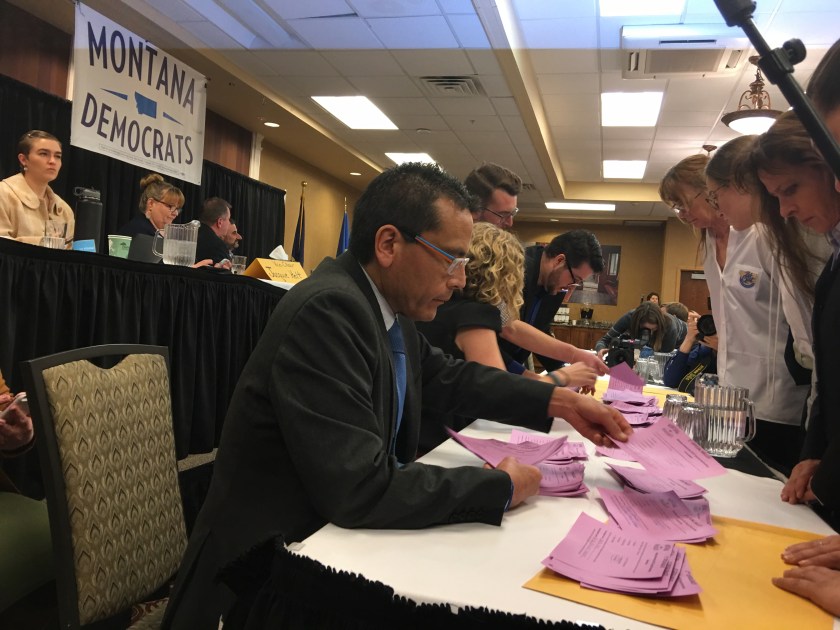
Montana Democratic Party officials counting votes after the first ballot. Photo credit: David de Sola
The Montana Republican Party is holding its nominating convention tomorrow. Several Democrats said they expect businessman Greg Gianforte – the GOP nominee in the 2016 gubernatorial race – to win the nomination. Gianforte lost his race in the same election that saw Donald Trump and Ryan Zinke win statewide by 20 and 16 points last November.
When asked what Quist and the Montana Democratic Party need to do to win, Williams said, “What Democrats have to do to win is continue to talk to seniors, workers, and Indian tribal people. With that combination, and a couple of other things thrown in, they used to win, and they can again.”


 politicalwilderness.com