Ron Estes Wins Kansas Special Election

2017-04-11 21.59.19
Democratic candidate James Thompson addressed reporters at his campaign’s election watch party shortly after losing the race. Thompson had the best performance of any Democrat in this district since 1996. (Photo credit: David de Sola)

WICHITA, Kan. – State treasurer Ron Estes was elected to the House of Representatives, despite a close race by his opponent, civil rights attorney and political novice James Thompson, who had the best performance of any Democratic candidate in this district in 21 years. In a district where Republicans enjoy a 2-1 party registration advantage that President Donald Trump and Rep. Mike Pompeo won by 27 and 31 points last fall, Thompson lost by just shy of seven points. This marks a 24-point shift in the Democrats’ favor in the same race from last November.

“What’s hard to get my head around is that the last time we elected a Democrat from this district was in 1992. The last time a Democrat candidate broke 40 percent of the vote was 1996, and the guy who ran five months ago got 31 percent more of the vote than the Democrat did. It’s huge momentum,” Kansas House minority leader Jim Ward (D-Wichita) said in an interview.

Though Thompson lost the race, the mood of the candidate and his supporters at the election watch party on Tuesday night was far from defeated. Thompson told reporters that Estes didn’t win the race, attributing the victory to the last-minute interventions of President Trump, Vice President Mike Pence, House Speaker Paul Ryan, Sen. Ted Cruz (R-Texas) and the National Republican Congressional Committee.  Thompson also called Estes “a weak candidate” and declared his candidacy for the same seat for the 2018 midterm elections, adding, “Mr. Estes won the battle, but he didn’t win the war.”
2017-04-10 16.20.47-1
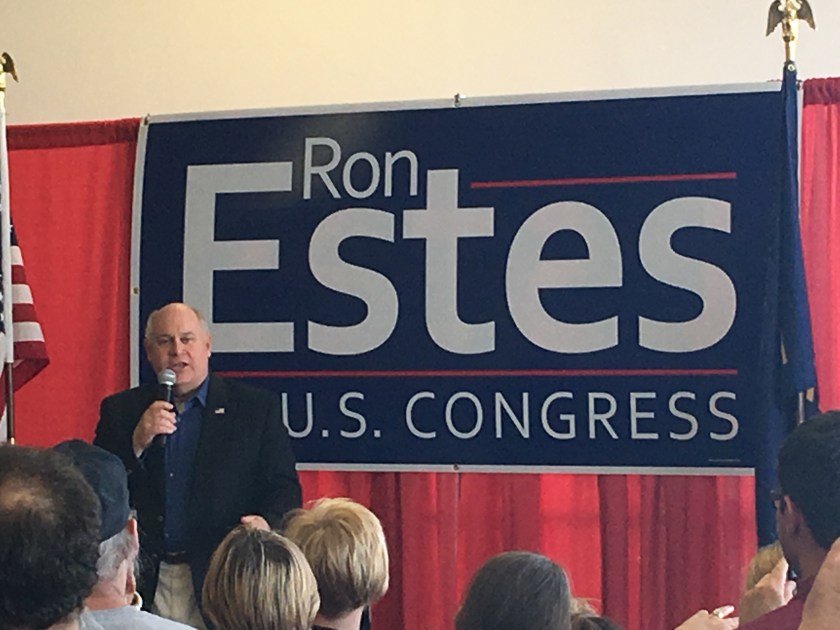
FILE PHOTO: Kansas Treasurer Ron Estes speaking to supporters at a rally the day before the election. (Photo credit: David de Sola)

During his victory speech, Estes took a shot at the skeptics who thought he was going to lose the race. From the Wichita Eagle’s report:

“We heard a lot from the national media and from people outside the state that we weren’t going to be able to win this race. We showed tonight that we were,” Estes said. “We’re still a Republican seat. … We sent a message across the country that we’re still Republican. That message should echo.

“For far too long, Washington hasn’t worked for us. We need to make sure that changes,” Estes said. “Tonight is a symbol of that.”

He dismissed “angst against the president” and that the election “was a chance for the Democrats.”

“We really showed the pundits tonight, didn’t we?” he asked, to applause and cheers.

Thompson started the night with strong numbers out of Sedgwick County – the most populous of the district’s 17 counties, which includes Wichita – in part because of early voting.  Estes was able to make up an initial deficit of nearly 6,000 votes in Sedgwick County in more rural counties in the district as well as voters who turned out on Election Day.  Thompson wound up winning Sedgwick County by 1,874 votes, but lost every other county in the district.
2017-04-11 14.51.45
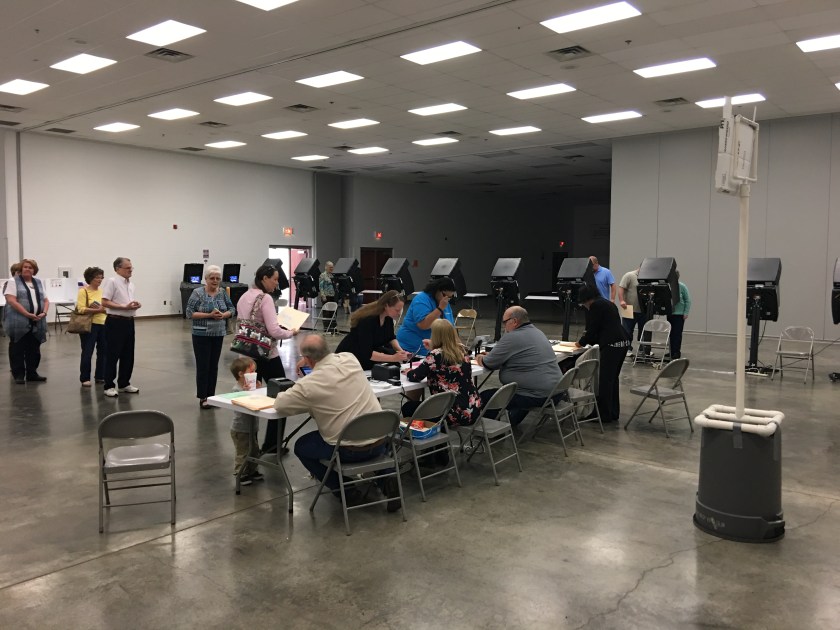
Voters at a Wichita area polling place on Election Day. (Photo credit: David de Sola)

Emily Percival, a registered nurse who works at a local hospital in Wichita, said she voted for Thompson because “I tend to care more about social issues than big business. Because of my profession, I frequently deal with the most vulnerable in our population,” and noted Kansas governor Sam Brownback’s recent veto of Medicaid expansion which passed with bipartisan majorities in both chambers of the state legislature.

Susan, a paraeducator and registered Republican, said she voted for Estes in part because of the national attention on the race. “The rest of the nation is looking at this election to see if we are supportive of Donald Trump’s initiatives,” she said, while also noting her pro-life position.  She added that she had some issues with the negativity of Estes’s campaign commercial attacking Thompson on abortion, but noted “There’s never a perfect candidate.”

Mike, a retiree and registered Democrat, said he voted for Thompson because, “I’m not satisfied with the state government, which is run by Republicans. We need a change of everything, from the president on down.”

Greg Gourley, a registered Republican who works in the aerospace industry, said he crossed party lines and voted for Thompson. “Estes would support Brownback. I don’t agree with the policies of the current administration.” He also noted that he had voted for some Democratic candidates in the past, adding, “I tend to vote the issues, not the party.”

Barbara, a retiree, said “[Estes] is the best man for the job. He’s against late-term abortions. He’s a Republican, and I’d like to replace [Mike Pompeo] with another Republican.”

Sedgwick County Election Commissioner Tabitha Lehman told the Wichita Eagle that turnout could potentially double the expected 20 percent, though final numbers were still not available.

Although Republicans managed to avoid what would have been a shocking upset in this race, now they must focus their attention on the special election in Georgia’s Sixth Congressional District scheduled for next week.  President Trump won that district by one point in 2016, and the Cook Political Report recently ranked the race as a toss up.

“The Democratic Party needs to remember there are more than just a few states that are in play. We need to make sure that they step up and help out and not wait until the last minute,” Thompson told reporters. “The national party was concentrating on Georgia. It’s a close race, and they should take that. We’ve shown that it’s possible. People didn’t give us credit here, didn’t think it was possible, but they came in at the last minute and tried to help out and we appreciate it. We need to make sure that we have a true 50-state strategy in place to make all races competitive.”

Though Thompson lost the election, Political Wire publisher Taegan Goddard noted the significance of the result: “A 20-point swing towards Democrats in KS-4 during Trump’s first 100 days — a.k.a. his honeymoon — is a political earthquake.”

According to Burdett Loomis, a political science professor at the University of Kansas, “[A Thompson win] would be a national event, interpreted as huge Trump loss. [A Thompson loss] under 10 point [margin] would be significant,” he wrote in an e-mail, noting this might make both national parties focus more attention on congressional races in the Second and Third Congressional Districts for the 2018 midterms.

Republicans Make Last-Minute Push to Defend Kansas Seat


2017-04-10 16.48.59
Sen. Ted Cruz (R-Texas) and Kansas State Treasurer Ron Estes mingle with voters after a campaign rally at a Wichita airport hangar. (Photo Credit: David de Sola)

WICHITA, Kan. – Sen. Ted Cruz (R-Texas) warned hundreds of local Republicans of the dangers of complacency as part of a last-minute push to turn out voters for state treasurer Ron Estes, the Republican candidate in tomorrow’s special congressional election.

“The eyes of the whole country are on Kansas,” Cruz said.

Tomorrow’s election is the first of Donald Trump’s presidency. It is also the first test of Democrats’ candidates, messages, strategies, and tactics since the presidential election. The seat previously held by Rep. Mike Pompeo had been safely Republican since the 1994 midterm elections. Though the political history and culture of the district and state at large favor Republicans, anecdotal evidence indicates that state and national Republicans are worried about losing the seat in a district that Donald Trump won by 27 points last November.  Republicans have tried to nationalize the race by tying Democratic candidate James Thompson to House minority leader Nancy Pelosi (D-Calif.), Senate minority leader Charles Schumer (D-N.Y.) and former presidential candidate Sen. Bernie Sanders (I-Vt.), who Thompson has openly cited as his inspiration for running for office. [Sanders’s post-election organization Our Revolution has endorsed Thompson.]

Besides Cruz’s last-minute campaign rally, the National Republican Congressional Committee made a $92,000 expenditure in this race. [According to the New York Times, the NRCC received a poll last week showing Estes ahead only by single digits.] House Speaker Paul Ryan sent out a fundraising email and donated $5,000. Vice President Mike Pence’s robocall, it was revealed today that President Trump himself recorded a robocall on Estes’s behalf.  The Cook Political Report shifted its assessment of the race from Likely Republican to Lean Republican. From their analysis:

Republicans familiar with recent polling describe extremely high Democratic intensity and very low GOP enthusiasm in what is likely to be a very low turnout special. More than that, Estes appears to be swept up in a last-minute vortex of factors outside his control: Democrats’ anger towards Trump, independents’ anger towards Gov. Sam Brownback and GOP dissatisfaction with early administration failures.

Estes himself was optimistic about the race entering the final stretch. “There’s been a lot of enthusiasm the last couple of weeks.  People are now starting to focus on April 11 and really going to turn out,” he said during a brief interview after the rally. “There’s a lot of people, a couple of weeks ago they were doing other things, maybe the basketball tournament. But now they’re focusing on the election and really want to have a representative.”

2017-04-10 16.20.47-1
State Treasurer Ron Estes addressing a campaign rally one day before Wichita area voters elect their new congressman. (Photo Credit: David de Sola)

The people at the rally were of all ages and walks of life. One local father took his two middle school-aged children out of class early so they could attend the rally on Monday afternoon, which he described as “a civics lesson.”

“I hope it turns out good,” Robert Pell, a Republican committeeman from Wichita said. He noted he had seen more yard signs for Thompson than Estes, who had not put out as many. He cited the Second Amendment and repealing Obamacare as his two major issues in this race.

Melissa Stout said this was her first campaign event, and she came to hear from both Cruz and Estes.  She ranked her issues in the election as “standing behind our president,” opposition to abortion, and support for the Second Amendment.

In his speech, Cruz mentioned four “big things” Republicans had on their plate for 2017: the Supreme Court, repealing Obamacare, regulatory reform, and tax reform.  “We have a Republican president, a Republican House and a Republican Senate. How about we act like it?” Cruz asked rhetorically, to applause from the audience. “If we accomplish all four things, 2017 will be a blockbuster year. If we fail, 2017 will be a heartbreaking year.”

A Thompson victory in the Fourth Congressional District would probably draw comparisons to Scott Brown’s improbable U.S. Senate victory in Massachusetts in 2010, though Thompson’s would not be as consequential to the balance of power in Congress. The special election in Georgia’s Sixth Congressional District scheduled for April 18 is another worry for national Republicans. The Cook Political Report recently rated the Georgia race as a toss up.

When viewed individually, the Kansas and Georgia races might be dismissed as a fluke.  Taken into conjunction, happening in two different regions of the country within the span of a week, both in districts considered safely Republican, these two races would cause alarm among Republicans. Less than one hundred days into the Trump presidency, they would be indicators of the volatility of the electorate going into 2018, particularly for Republican chances of retaining control of the House of Representatives.

Down to the Wire in Kansas

I’m traveling to Wichita tomorrow to cover the final days of the special election in the Fourth Congressional District, which is scheduled for next Tuesday.  Recent developments indicate a much closer race than predicted in a district Donald Trump won by 27 points last November. There are no public poll numbers available for this race, but recent actions taken by national Republicans to lock down this race speak volumes:

NOTE: I am told by the Sedgwick County Election Office that the early voting numbers are updated after the polls close at the end of each day, so more numbers will be coming today and in the days ahead. According to state law, early voting ends at noon on Monday.

Democrats shouldn’t get too cocky. Senator Pat Roberts and Governor Sam Brownback both won their respective races in 2014 despite showing abysmal early poll numbers and running less-than-stellar campaigns.

Kansas Democrat Faces Uphill Battle to Win Congressional Seat

The first congressional election of Donald Trump’s presidency is one week away. Although Republicans are strongly favored to retain the seat formerly held by Rep. Mike Pompeo, the race is seen as the Democrats’ first test of candidates, messages, strategies, and tactics in an effort to win a series of special elections over the course of the next three months, and to prepare for midterm elections in 2018. Kansas Democrats chose James Thompson, a civil rights attorney from Wichita, as their standard bearer to run against state treasurer Ron Estes. Can a Democrat win in a solidly Republican state representing a district that includes Koch Industries? The answer is yes, though it will be an uphill battle based on historical trends and more recent developments in the state. If elected, Thompson would be the first Democrat to hold the seat in more than two decades, and would be the only Democrat in the state’s congressional delegation.

Continue reading “Kansas Democrat Faces Uphill Battle to Win Congressional Seat”

Beto O’Rourke Will Run Against Ted Cruz in Texas 2018 Senate Race

Rep. Beto O’Rourke (D-El Paso) will announce on Friday plans to run for the U.S. Senate seat currently held by Republican incumbent Ted Cruz. From the Houston Chronicle:

WASHINGTON – U.S. Rep. Beto O’Rourke, a Democrat and ex-punk rocker who pulled a stunning upset to win his House seat six years ago, plans to declare his candidacy on Friday for the Senate seat held by Ted Cruz, according to Democratic sources in Texas.

O’Rourke’s fledgling campaign has scheduled an announcement on Friday in El Paso, his hometown. He has traveled heavily in Texas over the last three months making contacts, barely concealing his political plans.

“I’m very moved to do it,” O’Rourke, 44, said in an interview earlier this month, adding that he had reached the “emotional decision” about his candidacy.

Campaign aides declined to confirm that he will enter the 2018 Senate race.

The article also points out that Rep. Joaquin Castro (D-San Antonio) is still thinking about whether or not to get in this race, though the article notes that Castro has climbed the ladder in the Democratic House caucus farther and faster than O’Rourke, implying that Castro would have more to lose if his Senate run fell short. Most of the Texas Democrats I’ve spoken to in the past several weeks and months mentioned Castro as a probable candidate for 2018 and possibly their best (albeit longshot) chance at unseating Ted Cruz.

Bernie Sanders Group Endorses Democratic Candidates in Kansas and Montana

Our Revolution, the political organization that emerged in the aftermath of Bernie Sanders’s 2016 presidential campaign, endorsed James Thompson and Rob Quist, the Democratic candidates in the upcoming special elections in Kansas and Montana.

This will be an early test on whether the movement Bernie Sanders inspired in 2016 will turn out to elect other candidates in elections where he is not on the ballot. President Obama found out in 2010, 2014 and 2016 that it wasn’t a sure thing to turn out his supporters during elections when he wasn’t a candidate.  Quist supported Bernie Sanders in the 2016 primary, and Thompson said he was inspired to run for office by Sanders. Sanders won both states in the 2016 Democratic primaries. If Quist or Thompson can win these seats in red states, Sanders would probably become an even bigger kingmaker in Democratic politics, especially if he is getting political and ideological allies elected to Congress. Wins or narrow losses in these races would also hit the brakes on any fears of #DemExit becoming anything more serious than a social media hashtag, because progressives would show signs of being committed to staying within (and, perhaps in the long term, taking over) the Democratic Party.

Our Revolution has not endorsed candidates in the Georgia, South Carolina, or California special elections presumably because all three races are in the middle of ongoing primaries.  Quist and Thompson have already locked up their respective parties’ nominations. The Kansas general election is the first special election of the year, scheduled for April 11. The Montana general election is set for May 25.

Special Election Voter Registration Deadlines Approaching

There are five special elections to fill vacant congressional seats over the course of the next three months.

  • Kansas: (21 days before the election: March 21, 2017). Election Day: April 11
  • Georgia: March 20. Election Day: April 18, June 20 (if necessary)
  • Montana: (30 days before the election: April 25, 2017) Election Day: May 25
  • South Carolina: April 2 for primary, May 21 for general) Election Day: June 20
  • California: (March 20 for primary, May 21 for runoff) Election Day: April 4, June 5 (if necessary).

Millions of Americans Could Lose Health Insurance Under Republican Health Care Proposal

Congressional Republicans and the Trump Administration had 24 million reasons to be unhappy on Monday: that’s the number of Americans who would lose their health insurance under the Republican-crafted American Health Care Act by 2026, according to a cost estimate from the Congressional Budget Office.  The major findings of the CBO estimate:

  • The AHCA would reduce federal deficits by $337 billion from 2017-2026.
  • The biggest savings would come from reductions in Medicaid and the elimination of subsidies provided by the Affordable Care Act.
  • The biggest costs would come from repealing changes to the Internal Revenue Code caused by the ACA.
  • In 2018, there would be 14 million more uninsured people than under the current ACA law.
  • This figure will continue to increase by 21 million in 2020 and 24 million in 2026.
  • By 2026, an estimated 52 million people would be without health insurance, compared to 28 million people for current projections under the ACA.
  • The reduction in insurance coverage between 2018-2026 would be in large part from states discontinuing the Medicaid expansion program offered under the ACA.
  • In 2018 and 2019, average premiums for single policyholders would be 15-20 percent higher than under the current law. Average premiums would start to decrease in 2020.
  • By 2026, average premiums for single policy holders would be 10 percent lower than under the current law.
  • However, the savings on premiums (or lack thereof) vary by age:
    • For a 21-year-old: 20-25 percent less
    • For a 40-year-old: 8-10 percent less
    • For a 64-year-old: 20-25 percent higher
  • Medicaid spending would decrease by $880 billion from 2017-2026.
  • By 2026, Medicaid spending would be 25 percent less than what the CBO estimates currently under the ACA.

Republicans – who had previously cited CBO estimates as evidence to attack the ACA – had been preemptively attacking or trying to question the credibility of the agency in the days leading up to the estimate’s release. Gary Cohn, director of the White House National Economic Council, told Fox News, “We will see what the score is, in fact in the past, the CBO score has really been meaningless.” Health and Human Services Secretary Tom Price told reporters, “We disagree strenuously,” with the CBO’s findings.

Not all Republicans were optimistic about the proposed law, even before the CBO estimate was released. Sen. Tom Cotton (R-Ark.) warned House Republicans that they would be risking their majority if they voted for the AHCA, and told them, “Do not walk the plank and vote for a bill that cannot pass the Senate and then have to face the consequences of that vote.”

Opposition to the bill is not limited to Democrats. A variety of organizations ranging from the left, right and center have all publicly come out against the AHCA. They include the AARP, the American Hospital Association, the Federation of American Hospitals, the American Medical Association, the American Nurses Association, Heritage Action, Americans for Prosperity, the Club for Growth, Moveon.org, and the Center for American Progress.

Democrats attacked the AHCA almost immediately after its unveiling last week, because it finally gave them a concrete Republican policy proposal to target after nearly seven years of a vague and undefined “repeal and replace” pledge Republicans offered as an alternative to the ACA.  The CBO estimate will provide them with quantifiable data for campaign ads and talking points to target Republicans running for election or reelection in the 2017 and 2018 cycles.

In a statement, Democratic National Committee Chairman Tom Perez said, “Donald Trump’s ‘insurance for everybody’ pledge was a big fat lie.”

“The CBO, which is headed by a Republican-appointed director, just made it clear that Trump’s health care plan will cause up to 24 million Americans to lose their health insurance. At the same time, the plan slashes Medicaid, drives up the cost of care for older Americans, and defunds life-saving services provided by Planned Parenthood. The only winners here are Trump, and the corporations and rich people who get to pocket new tax breaks.”

“Of course, instead of admitting that the bill would leave millions without health insurance, Republicans are desperately trying to discredit the CBO with more ‘alternative facts.’ The American people are smarter than that.”

Tyler Law, spokesman for the Democratic Congressional Campaign Committee, issued a statement saying, “Every single House Republican owns this catastrophic bill and should be prepared for backlash at the ballot box, particularly given the anticipated loss of coverage for 14 million people as early as next year.”

UPDATE: Politico viewed a White House assessment of the AHCA which estimated 26 million Americans would lose their health insurance by 2026 – two million more than the CBO estimate. The explanation for the document from White House Communications Director Michael Dubke was, “This is OMB trying to project what CBO’s score will be using CBO’s methodology.”

Federal Court Strikes Down Racially Drawn Texas Congressional Maps

The Republican-controlled Texas state legislature racially gerrymandered a handful of congressional districts in order to diminish the electoral influence of the state’s minority populations, according to a San Antonio federal court ruling issued late on Friday night.  The two-judge majority wrote in their opinion, “This Court finds that map drawers acted with an impermissible intent to dilute minority voting strength or otherwise violated the Fourteenth Amendment and that Plaintiffs are still being harmed by the lines drawn as the direct product of these violations.” The ruling was the culmination of a long redistricting case pitting state Democrats, minority groups, and the Obama Justice Department against the Texas Republican leadership and legislature over the course of six years.

A potential consequence of this ruling is whether the state of Texas will once again have to seek federal approval before changing voting laws, a practice known as preclearance. The practice applied to Texas and several other Southern states with a history of racial discrimination, though that changed as a consequence of the Supreme Court’s 2013 decision in Shelby County v. Holder. The state is likely to appeal the decision to the Supreme Court.

The new ruling mentions the 23rd, 26th, 27th and 35th congressional districts.  The 23rd district covers much of West Texas and the Mexican border across to San Antonio, and is currently represented by Rep. Will Hurd. The 26th district covers a suburban area north of Dallas/Fort Worth and is represented by Rep. Michael Burgess. The 27th district covers part of the Texas coast on the Gulf of Mexico, as well as the outskirts to the southwest of the capital city of Austin, and is currently represented by Rep. Blake Farenthold. The 35th district covers a stretch between San Antonio and Austin, and is represented by Rep. Lou Doggett.  Doggett is the only Democrat representing the four districts named in the ruling.  Hurd has been identified by both parties as one of the most vulnerable Republican incumbents in the 2018 election. He narrowly won a rematch with his Democratic predecessor by one point, in a district with a 68 percent Hispanic population that Hillary Clinton won by 3 in the presidential election. The court ordered the Texas legislature to redraw lines for the 23rd, 27th and 35th districts.

This is the latest in a series of legal rulings against congressional redistricting in the aftermath of the 2010 census.  Other courts have ruled against Republican gerrymandered maps in Alabama, North Carolina, Virginia and Wisconsin.

“This Texas ruling is another major legal victory for fairer maps in America,” National Democratic Redistricting Committee General Counsel Marc Elias said in a statement. “Yet again, courts have sent a clear message that unconstitutional racial gerrymandering and violations of the Voting Rights Act will not stand in the United States of America. The National Democratic Redistricting Committee will act quickly on a proactive legal strategy that will build upon these recent victories.”

Democratic Legislative Campaign Committee Executive Director Jessica Post said, “Texas Republicans illegally diluted the voices of Hispanic voters, and this ruling is an important step towards giving all Texans fair representation.”

“The Texas congressional map engineered by Republican legislators diminished the voices of specific groups of voters just to protect GOP power. This court decision, along with recent rulings in Virginia, Alabama, and Wisconsin, mark important progress in the fight to protect and enfranchise all voters and are blows against the artificial Republican majorities the GOP created at minority voters’ expense.”

“The federal court further confirmed what we’ve known all along:  Texas intentionally discriminated to disenfranchise Latino and African American voters.  This is unacceptable and that is why I led the effort at the Justice Department to challenge these maps.  But our work here is far from over,” Democratic National Committee Chairman Tom Perez said in a statement.

“Republicans have ensured that the dark days of discrimination in Texas continue to loom, but the sun will soon shine. In time, justice prevails,” Texas Democratic Party Chairman Gilberto Hinojosa said.

No statements on the court ruling have been released by the Republican Legislative Campaign Committee, the Republican National Committee, or the Texas Republican Party.

UPDATE: Read this analysis of the case from Election Law Blog’s Rick Hasen. He calls the ruling “a major victory for voting rights plaintiffs,” and notes there is a real question of whether or not Texas will be subject to Section 5 preclearance for as long as ten years.

South Carolina Democrats Will Have a Primary

After nearly 48 hours as the only declared Democrat running in South Carolina’s Fifth Congressional District, Archie Parnell will have competition in the form of Alexis Frank, who declared her candidacy for the special election today. Here’s the statement from South Carolina Democratic Party Chairman Jaime Harrison:

“I commend Alexis Frank for jumping into this race.  Democrats in the 5th District are looking forward to a substantive primary campaign to hear how all the candidates would work to improve people’s lives.  With Donald Trump and his rubber-stamp Republican Congress threatening to cause great harm to millions of Americans, the stakes could not be higher.  Whoever 5th District Democratic primary voters choose, I am confident that Democrats will be unified behind a nominee with an agenda to bring South Carolinians together and expand opportunity for all.”

This means Parnell’s hope of winning the nomination by default as the only Democrat in the race is over.  He and Frank will have to compete for the party’s nomination in the primary, scheduled for May 2. Candidates from both parties still have until Monday, March 13 to file the papers to get in the race.  If one or more Democrats decide to do so, and neither Parnell nor Frank are able to get a majority of the vote on May 2, there is a runoff scheduled for May 16 if necessary.

UPDATE: I just spoke with Frankie Norstad, who helped launch Alexis Frank’s campaign. The paperwork was filed this afternoon, and her staffing, website, social media, campaign fundraising, etc. should be up and ready to go by Monday.

Some biographical information about the candidate, all from Norstad:

  • Alexis Frank is a 26-year-old mother of two children married to a U.S. Marine currently based in North Carolina.
  • She was born in Hartsville, S.C. and is a graduate of Rock Hill High School, where her mother is still a teacher. Her brother teaches at Winthrop University in Rock Hill, and is openly gay.
  • She enlisted in the Army Reserve at 17, and worked as an Army paralegal for six years.
  • She is two weeks away from graduating with a degree in Project Management.
  • This is her first run for elected office.
  • Frank first thought about running for the seat a little more than two weeks ago, after she saw an online video produced by Norstad looking for candidates to run in the upcoming special elections. She made the decision to run this morning.
  • Norstad: “This girl is hope and passion bottled up and delivered.”