Rob Quist Wins Democratic Nomination

2017-03-05 16.14.32.jpg
Rob Quist and his family speaking to reporters after winning the Montana Democratic Party nomination to run for the state seat in the House of Representatives.
Photo credit: David de Sola

HELENA, Mont. – Rob Quist, a political novice from Flathead Valley, won the Montana Democratic Party’s nomination to run for the state’s at-large seat in the House of Representatives.  Quist, a musician, will face off against the Montana Republican Party’s nominee in a special election scheduled for May 25 to fill the seat vacated by Republican Rep. Ryan Zinke, who was confirmed as Secretary of the Interior last week.

“I really feel like I’ve been representing the state of Montana all my life, through my music,” Quist told reporters after his victory. “Instead of playing music and providing entertainment for people, we’ll be giving speeches and hopefully trying to energize people.”

“I really feel that with my connection to the people of the state of Montana, and they recognize that I’m someone that stood up for Montana values all my life,” he added. “I really don’t feel like I’m the underdog here.”

Former Rep. Pat Williams agreed with that assessment, saying “Rob Quist has a bit of an upper hand because he’s known throughout Montana, particularly in eastern Montana, small towns, and the bigger cities. They know him, so he’s going to do well.”

Dawn Gandalf, Vice-Chair of the Sanders County Central Committee, addressed the issue of the party not reaching out to rural communities and voters, which was the subject of at least one meeting during the Democratic National Committee’s winter meeting in Atlanta last week.  “To have the state start getting involved in recognizing rural communities, it’s been a problem in our state because we are such a huge state,” she explained. “All the attention and funds have gone to the seven or eight top cities, urban cities, and nothing to the outlying. So on the outlying communities, you have people who are voting, but they’re neglected and there’s no support.”

She cites Sanders County – a rural county in the northwest part of the state – as an example, saying it has become “a stranglehold of the Tea Party.” According to the Montana Secretary of State, Donald Trump won this county by a whopping 73-21 margin.

Quist won the race on the fourth and final ballot 90-69 in a head-to-head matchup with State Rep. Amanda Curtis (D-Billings). Curtis became the party’s nominee in the 2014 Senate race against Steve Daines, after interim Senator John Walsh dropped out of the race because of a plagiarism scandal.  Quist’s victory was announced by Williams, who was the last Democrat to represent Montana in the House of Representatives from 1979 to 1997.

“I feel better about Democrats’ chances now than I’ve had in quite a number of years,” Williams said during an interview. “In my opinion, this is going to be a very good race for Democrats.”

2017-03-05-16-47-35
Montana Democratic activists and delegates gathered after the convention to discuss plans for Quist’s campaign over the next 80 days. The general election is scheduled for May 25.
Photo credit: David de Sola

One early sign of energy among the Democratic base in the state was the Women’s March in Helena on January 21. Gandalf said that while organizers originally estimated a turnout of 1,200, the actual number who came to the march was 10,000.

That energy may not necessarily be limited to Montana. Dan West, a former Obama administration political appointee at NASA who ran for the party’s nomination in this race and dropped out after the second ballot, felt optimistic about this race getting national attention and support from Democrats outside the state. “The national party is eyeing [this special election]. There’s no other races happening right now to funnel money away,” he said during an interview. West added that he would send out an email to his Obama alumni network to urge them to support Quist in this race.

During his closing speech before delegates began voting, Quist offered unequivocal defenses of the Affordable Care Act, Planned Parenthood, public lands, and public education. Despite the fierce opposition to Republican-controlled Washington that has been building within the Democratic base nationwide, Quist is running on a platform of state issues that matter to voters, not hardline opposition or obstructionism. “He’s not running against Paul Ryan or Donald Trump,” Gallatin County Vice-Chair Elizabeth Marum said. “He’s running to put everyday average Montanans at the forefront of his optics, and we have a lot of needs.”
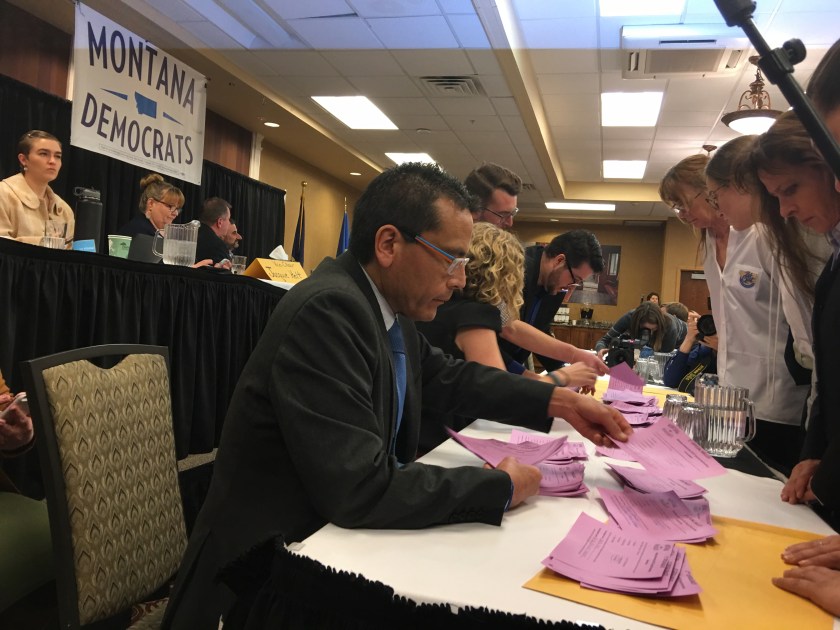
2017-03-05-14-09-13
Montana Democratic Party officials counting votes after the first ballot.
Photo credit: David de Sola

The Montana Republican Party is holding its nominating convention tomorrow. Several Democrats said they expect businessman Greg Gianforte – the GOP nominee in the 2016 gubernatorial race – to win the nomination.  Gianforte lost his race in the same election that saw Donald Trump and Ryan Zinke win statewide by 20 and 16 points last November.

When asked what Quist and the Montana Democratic Party need to do to win, Williams said, “What Democrats have to do to win is continue to talk to seniors, workers, and Indian tribal people. With that combination, and a couple of other things thrown in, they used to win, and they can again.”

Quist and Curtis Will Face Off in Fourth and Final Ballot

HELENA, Mont. – Montana Democratic Party delegates were still divided on the third ballot, with no winner emerging.  The results:

  • 160 votes were cast.
  • Rob Quist:  72
  • Rep. Kelly McCarthy: 37
  • Rep. Amanda Curtis: 51

Kelly McCarthy, the lowest-vote getter, was eliminated from the fourth and final ballot, which will be Rob Quist and Amanda Curtis in a head-to-head matchup.  McCarthy lost five votes from the second ballot, while Quist and Curtis increased their tallies by 10 and four votes respectively.  A minimum of 81 votes are necessary to secure the nomination.

Voting for the fourth ballot is under way.

Three-Way Race Between Quist, McCarthy and Curtis Emerges After Second Ballot

HELENA, Mont. – Montana Democrats were not able to pick their congressional nominee on the second ballot. The results:

  • 160 votes were cast.
  • Rob Quist:  62
  • Rep. Kelly McCarthy: 42
  • Gary Stein: 1
  • Rep. Amanda Curtis: 47
  • Dan West: 8

Dan West dropped out of the race after the second ballot. Gary Stein was eliminated as the lowest vote-getter on the second ballot.  Voting on the third ballot is underway, with Rob Quist, Kelly McCarthy and Amanda Curtis as the remaining candidates.

No Winner on the Montana Democrats’ First Ballot

HELENA, Mont. — None of the eight candidates running for the Montana Democratic Party’s nomination for the upcoming state congressional election came away with a 50 percent plus one majority after the first ballot. The results announced by Montana Democratic Party Chairman Jim Larson:

  • 158 votes were cast.
  • 1 vote was spoiled and did not count.
  • Rob Quist:  57
  • John Meyer: 0
  • Rep. Kelly McCarthy: 38
  • Gary Stein: 6
  • Tom Weida: 0
  • Link Neimark: 0
  • Rep. Amanda Curtis: 39
  • Dan West: 17

There is currently a ten-minute break before the second ballot, which will consist of Quist, McCarthy, Stein, Curtis, and West.  Under the rules, Meyer, Weida and Neimark are eliminated.

Things Missing from this Montana Republican Candidate’s Television Ad

This ad by Republican candidate Greg Gianforte just aired on a Montana television station, less than 48 hours before the Montana Republican Party’s nominating convention.

Aside from the reference to “drain the swamp” in the voiceover narration, it’s worth noting what the ad does NOT mention:

  • Donald Trump (though presumably implied by the “drain the swamp” line)
  • Republican Party (Montana or national) – the ad and his website say “Paid for by Greg for Montana”
  • Paul Ryan
  • Repealing or replacing the Affordable Care Act
  • Muslim ban or Travel ban
  • Building a wall on the Mexican border

He’s running entirely on local issues, with no mention of the Trump/Ryan agenda.  Also worth keeping in mind is that Gianforte benefits from some name recognition over the other candidates in the Republican field as he was the Republican candidate for governor in 2016. (He lost to incumbent Democrat Steve Bullock 50-46, in a state Donald Trump won 55-35.)

Preview of the Montana Nominating Conventions for State Special Election

I’m in Helena, where I will be covering the Montana Democratic Party’s nominating convention tomorrow to pick a candidate to run for the state’s at-large congressional seat, which was vacated when Ryan Zinke was confirmed as Secretary of the Interior. As was the case at the DNC winter meeting, I will be blogging and posting updates from the convention.

On a related note: Matt Volz of the Associated Press has three stories (here, here and here) previewing the state of the race as both major parties and the Libertarian Party prepare to pick their nominees (the Montana GOP’s nominating convention is on Monday). The general election is scheduled for May 25.

2017 Special Election Calendar

Having spoken to and emailed several party officials, here is what the special elections schedule looks like over the next three months to fill the five vacant seats in the House of Representatives:

March 5-6 – Party nominating conventions for Democratic and Republican candidates for Montana AL CD.
April 4 – California 34th CD primary election
April 11 – Kansas 4th CD general election: Ron Estes (R) v. Jim Thompson (D)
April 18 – Georgia 6th CD general election
May 2 – South Carolina 5th CD primary
May 16 – South Carolina 5th CD primary runoff election (if necessary)
May 20 – Montana AL CD general election: Greg Gianforte (R) v. Rob Quist (D)
June 6 – California 34th CD general election (the top two candidates from primary, if no candidate gets 50 percent of the votes +1 on April 4)
June 20 – Georgia 6th CD runoff election (only if no candidate gets 50 percent of the votes +1 on April 18)
June 20 – South Carolina 5th CD general election

Tim Ryan Won’t Run for Ohio Governor in 2018

After months of flirting with the idea, Rep. Tim Ryan told Ohio Democrats he would not be entering the race to succeed term-limited Governor John Kasich:

CLEVELAND, Ohio — Tim Ryan, whose national profile has risen in recent months, announced Tuesday that he will not be a candidate for Ohio governor in 2018.

The eight-term congressman wrestled with a run for months, weighing the risk of jumping into a potentially crowded and unpredictable primary against sticking with a safe House seat.

“Constituents in my district are at the forefront of an economic transformation that has hollowed out our nation’s middle class,” Ryan said in a statement emailed after word about his decision first trickled out to cleveland.com. “As I’ve considered how best to address these challenges, the more I’ve appreciated how much they are national issues that require national solutions.

“That is why, while I have been truly humbled by the encouragement I’ve received to run for Governor of Ohio, I believe the best way to serve my community, my state and my country is to remain in the United States Congress.

Ryan’s decision was made easier by the plum committee assignments he maintained despite his unsuccessful bid to unseat Minority Leader Nancy Pelosi last fall. In his Tuesday statement, he asserted that spots on the Appropriations Committee and Defense Subcommittee will help him “fight back against wrong-headed policies and champion the kinds of solutions that would have a real impact for American families.”

With Ryan’s decision to not enter the race, the Democratic field is wide open. According to cleveland.com’s Henry Gomez, the potential field of candidates includes:

  • Ohio Senate minority leader Joe Schiavoni
  • Former Rep. Betty Sutton
  • Former Rep. Connie Pillich
  • Dayton Mayor Nan Whaley
  • Former Youngstown Mayor Jay Williams
  • Former Sen. Nina Turner
  • Former Rep. Dennis Kucinich
  • CFPB Director Richard Cordray

While the race for an open governor’s mansion in Columbus is ongoing, at the same time Sen. Sherrod Brown will be running for reelection in the same cycle. Depending on the political climate in 18 months from now, that could be a boost for Democrats up and down the Ohio ballot.

Montana Democrats Preparing to Pick Their House of Representatives Nominee

Montana Democrats are tentatively set to pick their nominee to compete for the state’s at-large congressional seat being vacated by Republican Rep. Ryan Zinke, who is expected to be confirmed as Secretary of the Interior by the Senate. The state party is planning to hold its nominating convention in Helena this coming weekend.

According to a Montana party official, the voters who will be picking the candidate are divided into four different groups:

  • The 35 county Central Committees, each of which gets four delegates.
  • Elected officials and party leaders (This includes Governor Steve Bullock, House Minority Leader Jenny Eck, and Senate Minority Leader Jon Sesso)
  • The executive board of the Montana Democratic Party
  • Partner organizations (Examples include, but are not limited to, the MEA, AFL-CIO, Young Democrats, Big Sky Democrats, and Stonewall Democrats)

There are eight candidates running for the nomination:

  • Kelly McCarthy (Legislator, Billings)
  • Amanda Curtis (Legislator, Billings)
  • Rob Quist (Musician, Flathead Valley)
  • Dan West (Former Obama administration official, Missoula)
  • John Meyer (Environmental attorney, Bozeman)
  • Gary Stein (Teacher, Missoula)
  • Link Neimark (Business owner, Whitefish)
  • Tom Weida (Traveling salesman, Helena)

The candidates have to be physically present at the nominating convention, they cannot send a proxy or representative on their behalf. Each candidate has to be nominated by one of the voting delegates. There is a short comment period for candidates and delegates to make their arguments on who the delegates should vote for, followed by the voting.

There will be an estimated 180-200 votes at the convention. A candidate needs 50 percent of the votes plus one to win.  If none of the candidates are able to get a majority, delegates vote on another ballot. This process continues until a winner with a majority of the vote prevails. The winner will square off against the Montana Republican Party’s nominee in a special election, which will tentatively be scheduled 85-100 days after Zinke’s resignation from the House of Representatives.

Candidates Named for Kansas Special Election

After Mike Pompeo’s resignation from Congress to take the job of CIA director, there will be a special election to fill his former seat, which represents Kansas’s 4th congressional district. The Kansas Democratic Party held a convention today in the 4th CD to pick their nominee for the race. narrowing down a field of five candidates before finally choosing civil rights attorney James Thompson after two rounds of voting

Republicans chose state treasurer Ron Estes as their candidate. The election will take place on April 11.  According to the Wichita Eagle, Democrats will try to tie Estes to President Donald Trump and Kansas governor Sam Brownback, while Republicans will try to tie Thompson to House minority leader Nancy Pelosi. According to the Cook Political Report, the 4th CD has a R +14 Partisan Voter Index. Presidnet Trump won Kansas 56-35 in the 2016 election.