Massachusetts and Virginia Join Lawsuits Against Federal Government Over Trump Executive Order

Massachusetts Attorney General Maura Healey announced her office would be joining a lawsuit against the federal government over President Trump’s controversial executive order. The original plaintiffs were the ACLU of Massachusetts and private attorneys on behalf of two associate professors from the University of Massachusetts at Dartmouth.

It is worth noting that, among the several statements in support of the lawsuit from state officials as well as representatives from the private sector and academia is this comment from Republican governor Charlie Baker:

“Massachusetts is a global community and we all benefit from the shared experiences of our partners from around the world to support our economy and educational institutions to make our state the best place to live, work and raise a family. The recent executive order puts this at risk, will not improve our security, and the lack of guidance associated with such an abrupt and overwhelming decision is problematic for all involved.  Our administration has worked with the Attorney General’s office and supports her challenging this action. We look forward to the courts resolving this matter expeditiously.”

Virginia Attorney General Mark Herring also filed a motion to intervene in Aziz v. Trump et al. in the Eastern District of Virginia, effectively making the state a plaintiff in the case. The motion says in part:

The Commonwealth has substantial interests justifying its intervention. Virginia has a substantial interest in protecting its public universities and their faculty and students from the academic and fiscal disruption posed by the Executive Order. The Executive Order impairs the ability of students who are lawful permanent residents or present on student visas from continuing to attend Virginia’s public colleges and universities. That impairment will hamper the ability of Virginia’s colleges and universities to attract and retain foreign students in the future and result in a significant loss of tuition revenue to the Commonwealth. The Executive Order also hinders the travel of faculty members and other educational personnel employed by Virginia’s public colleges and universities. Faculty members and students who are unable to travel likely will be forced to forfeit their grant moneys. Moreover, Virginia has a quasi-sovereign interest “in the health and well-being —both physical and economic—of its residents in general,” which will be impaired if Virginia is not permitted to intervene.
Herring’s office also filed a separate brief in support of the motion to intervene.
That makes three states which have joined lawsuits against the federal government yesterday alone.

Democrats Skipping Meeting with Trump Supreme Court Nominee Tonight

From NBC’s Kelly O’Donnell:

New York Attorney General Joins Lawsuit Against Trump Administration

New York Attorney General Eric Schneiderman’s office just sent out a press release announcing it would be joining a lawsuit challenging the Trump administration’s immigration executive order that was signed last Friday. The lawsuit was originally filed by the American Civil Liberties Union Foundation, the Jerome N. Frank Legal Services Organization at Yale University, the Urban Justice Center, and the National Immigration Law Center.

Schneiderman’s statement:

“As I’ve made clear: President Trump’s executive action is unconstitutional, unlawful, and fundamentally un-American.

“That is why my office will be filing to join the federal lawsuit against President Trump and his administration. I’m proud to partner with these organizations to fight to permanently strike down this dangerous and discriminatory order.

“I will continue to do everything in my power to not just fight this executive order, but to protect the families caught in the chaos sown by President Trump’s hasty and irresponsible implementation – including pressing DHS and CBP to provide a full list of those still detained and allow them access to legal service providers.”

City of San Francisco Sues Trump Administration

Following up on the earlier story of Washington Attorney General Bob Ferguson filing a lawsuit against the federal government, the City of San Francisco has filed a suit of its own. (Read the PDF of the complaint here) In this case, it targets the administration’s executive order on sanctuary cities, which would result in loss of federal funding for San Francisco.

According to the press release from City Attorney Dennis Herrera’s office, “This lawsuit challenges the constitutionality of the executive order and a related federal statute. It requests a finding that San Francisco complies with applicable federal law and seeks to prevent the federal government from cutting funds to San Francisco.”


Democrats’ Legal Wars with Trump Administration Have Begun

A group of sixteen Democratic state attorneys general met in Florida over the weekend and issued a joint statement blasting President Trump’s controversial executive order which led to the detention of travelers from seven Muslim nations at airports throughout the United States:

“As the chief legal officers for over 130 million Americans and foreign residents of our states, we condemn President Trump’s unconstitutional, un-American and unlawful Executive Order and will work together to ensure the federal government obeys the Constitution, respects our history as a nation of immigrants, and does not unlawfully target anyone because of their national origin or faith.

“Religious liberty has been, and always will be, a bedrock principle of our country, and no president can change that truth.

“Yesterday, multiple federal courts ordered a stay of the Administration’s dangerous Executive Order. We applaud those decisions and will use all of the tools of our offices to fight this unconstitutional order and preserve our nation’s national security and core values.

“We are confident that the Executive Order will ultimately be struck down by the courts. In the meantime, we are committed to working to ensure that as few people as possible suffer from the chaotic situation that it has created.”

Federal judges in four states issued orders temporarily forbidding the removal of some individuals that were affected by the executive order which led to protests at airports across the country.

Washington state Attorney General Bob Ferguson filed a lawsuit this morning against the federal government seeking to invalidate President Trump’s executive order. (Read the PDF of the complaint.) In addition, Ferguson filed a motion for a temporary restraining order seeking to “temporarily bar enforcement of the Order nationwide.”

At a press conference, Ferguson said that Amazon and Expedia – tech companies both based in Washington state – would be filing declarations of support with the lawsuit. A Microsoft representative said that the company would also be supportive of the lawsuit. Both the lawsuit and the restraining order mention that the tech industry relies on skilled immigrants working under the H-1B visa program. The filings say the executive order would adversely impact the companies’ employees and in the case of Expedia, some of its customers, who are travelers with passports from the seven countries named in the order. The lawsuit also mentions that 230 students from the affected countries are currently enrolled at the University of Washington and Washington State University.

This is the first of what will likely be several lawsuits against the federal government regarding this executive order. The issue will probably eventually make its way to the Supreme Court.

DNC Candidates Join Airport Protest

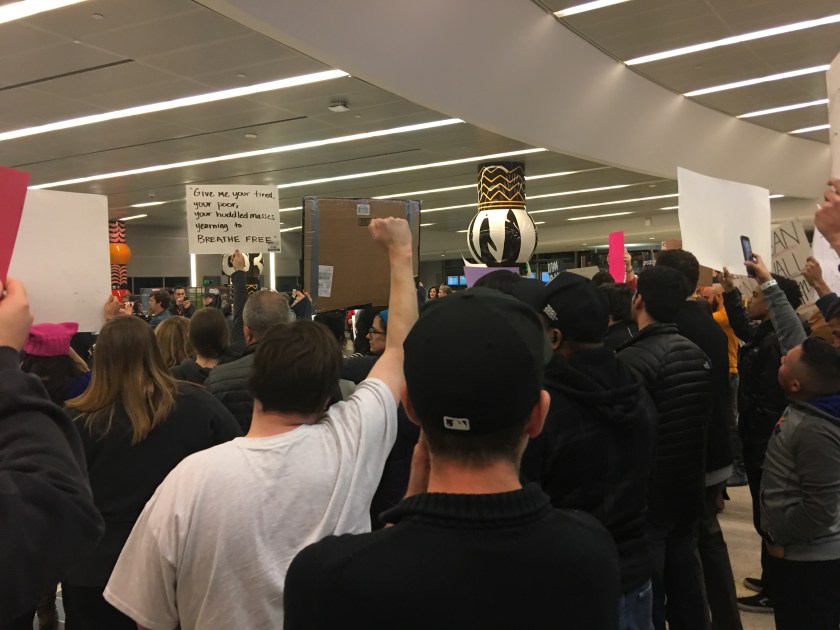
HOUSTON – “Sign me up for the Resistance,” South Bend, Indiana Mayor Pete Buttigieg told an auditorium full of Democratic Party insiders and activists on Saturday afternoon. Several hours later, he and three other candidates running for leadership positions in the Democratic National Committee were in the middle of a protest at George Bush Intercontinental Airport to protest the Trump administration’s executive order on immigration and refugee resettlement.

2017-01-28-21-36-06
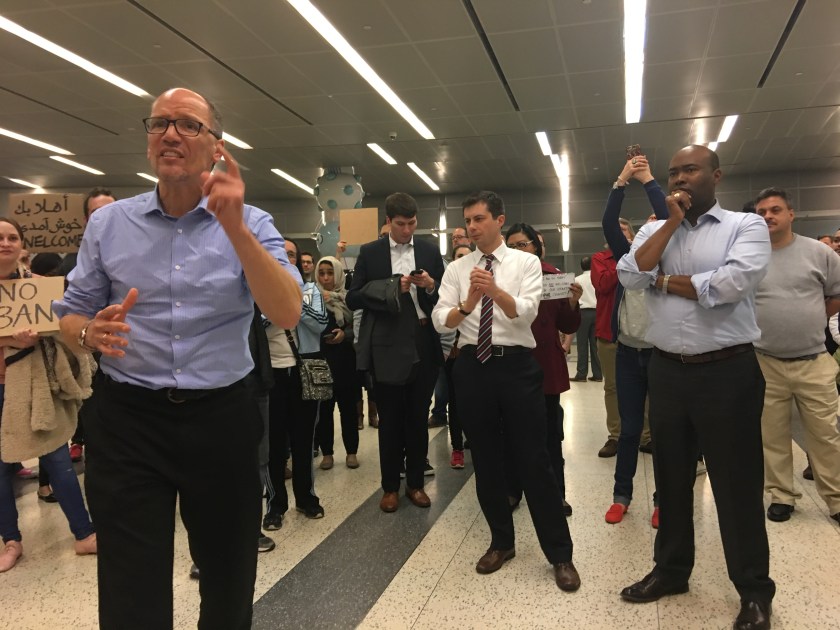
DNC chair candidates Tom Perez, Pete Buttigieg and Jaime Harrison speak to protestors outside Terminal E at George Bush Intercontinental Airport. (Photo credit: David de Sola)

They joined a crowd of approximately one hundred people that had gathered outside Terminal E, the international arrivals terminal, joining similar protests that broke out at airports across the country.  As was the case at other protests, according to Politico’s Gabriel Debenedetti, a group of local lawyers was present. They had gathered there to offer potential legal assistance to travelers who might be affected by the executive order. Though the crowd at Houston wasn’t as big as other airports, the city itself is the fourth biggest destination in the world for refugee resettlement, according to the Houston Chronicle.

Also on the scene were former Secretary of Labor Tom Perez and South Carolina Democratic Party Chairman Jaime Harrison, as well as Democratic National Committee Vice Chair Maria Elena Durazo. Buttigieg, Perez and Harrison are candidates running to be the next chairman of the Democratic National Committee. Durazo is running for reelection to her current post.  All four were in Houston on Saturday for a regional forum sponsored by the DNC for candidates running for leadership positions ahead of the party’s election scheduled to take place at the end of February.

“I think it’s great that we have the organization and infrastructure, the activity and activism, and the heart and soul to stand up to what Donald Trump is doing,” Durazo said in an interview. “We have never seen this many protests, this many demonstrations in the numbers, in the consecutive days of activity, from Saturday the Women’s March, to Philadelphia, to tonight. It’s unfortunate that the reasons are Donald Trump is signing these executive orders and because he’s so hell-bent on violating our constitutional rights.”

2017-01-28-21-38-41-1
DNC Vice Chair Maria Elena Durazo speaks to protestors outside Terminal E at George Bush Intercontinental Airport. (Photo credit: David de Sola)

Tom Perez took advantage of his fluency in Spanish and addressed protestors and local media in both languages. “Somos los Estados Unidos, no somos los Estados Divididos.” We are the United States, not the Divided States. It is worth noting one dynamic from the election which probably played a part in Saturday’s protests: the urban-rural split between liberals and conservatives. Because liberals tend to concentrate in large cities, many of which have international airports, that is probably one reason why these protests were able to organize and mobilize so quickly, even in a historically conservative state like Texas.

“We knew this would be a day of reckoning when Donald Trump assumed the Oval Office,” he told protestors. “We didn’t know it would come this fast. Lady Liberty has taken a few body punches, but the American people will fight back.”

2017-01-28-20-43-58
Photo credit: David de Sola

Harrison cited the famous quote by Pastor Martin Niemöller, as well as a quote from Dr. Martin Luther King’s Letter from a Birmingham City Jail: “We will have to repent in this generation not merely for the actions and words of the bad people but for the appalling silence of the good people.”

“We are that shining beacon on a hill,” Harrison said during an interview. “We will get back to that point once [Donald Trump] is no longer president.”

“Resistance is not futile, resistance is necessary. We cannot allow this man to destroy this great nation, to destroy the reputation that it’s had for generations.”

2017-01-28-21-07-57
Pete Buttigieg and Jaime Harrison join the crowds protesting the Trump administration’s executive order. (Photo credit: David de Sola)

Buttigieg, who at one point acted as an Arabic-English interpreter for a newly arrived family and the crowd gathered outside the terminal, said during an interview, “Every time there’s another outrage, there’s going to have to be another response.”

“We have to make sure it’s not just reactive to what they do. We got to make sure that we’re building a proactive agenda around freedom, around fairness, around protecting families, and around our future.”

Six Out of Seven DNC Chair Candidates Skip Women’s March

New York Times reporter Maggie Haberman pointed out:

According to the Free Beacon, six out of the seven candidates running for chairmanship of the Democratic National Committee were in Florida last Saturday during a retreat of major Democratic donors organized by David Brock. The one exception: South Bend mayor Pete Buttigieg:

Brock’s retreat was planned independently of the Women’s March which took place the day after Donald Trump’s inauguration. If any of them had known that march was going to be as big of an event as it was, they all probably would have gone to the nearest local march. This also raises the issue about the party’s relationship with donors and big money, a question which came up during the first DNC regional forum in Phoenix as well as interviews with the different candidates running for the job.  One question to watch in Houston this weekend will be whether Buttigieg uses this issue to distinguish himself from the rest of the candidates.

One other point worth mentioning about the Women’s March: George W. Bush had to start a war two years into his presidency to get that kind of global opposition and protest against him.  Donald Trump accomplished it on the second day of his presidency.

Becerra Confirmed as California Attorney General

The California state Senate voted to confirm Rep. Xavier Becerra as the state’s next attorney general on a party line vote of 26-9.  Becerra will be sworn into office tomorrow after his resignation from Congress, some time before Governor Jerry Brown’s State of the State address.

In a statement, Becerra said, “I’m deeply grateful to the State Senate for voting, like the State Assembly, to confirm me as California’s Attorney General.

It is humbling and exciting to assume responsibility for vigorously advancing the forward-leaning values that make California unique among the many states.”

Politically, the California attorney general job is a much bigger platform for the national stage for Becerra than if he had remained in the Democratic minority in the House of Representatives. As the state’s top law enforcement officer, he will most certainly be involved in litigation with the Trump administration on issues ranging from immigration, the environment, and civil rights. If he wants to run for the Democratic nomination in 2020 or wants to be a strong contender in a future Democratic administration, being in the legal trenches fighting against the Trump administration would probably make for a very good credential, particularly if he can get legal victories in federal court or the Supreme Court.

California Is the New Texas

There are two stories worth reading about the role California might play in the years ahead as an opposition foil to Donald Trump. Democrats control the state – the governor’s mansion, combined with supermajorities in both chambers of the state legislature. Essentially, California will – possibly in tandem with other states like New York, Massachusetts and Illinois – assume the role that states like Texas played during the Obama presidency.

First, this story from NPR:

There are several ways the state may challenge Trump and congressional Republicans. It may simply choose not to not enforce some federal laws it disagrees with and enact stronger state laws around environmental and consumer regulations. The state is also likely to aggressively file lawsuits against the federal government.

To that end, Brown’s pick to be California’s next attorney general, Congressman Xavier Becerra will play a high-profile role. Becerra said the state isn’t looking to pick fights but won’t be afraid to go to court either.

“My obligation is to protect my state, to promote the interests of my state,” said Becerra.

It may sound unusual for a liberal state like California to resort to an appeal to states’ rights. For the past eight years, conservative states have argued for their autonomy with respect to the federal government.

But states are opportunistic about their use of states’ rights arguments and tend to employ them when their party doesn’t control Washington, says Carlton Larson, a law professor at the University of California, Davis. Still, Larson says California may want to be careful about how much it uses that argument.

“If we were to push back very, very heavily against federal law, there’s a real danger,” that environmental and civil rights laws that depend on a broad reading of federal law could be endangered, said Larson.

Democrats have already introduced one bill to better train defense attorneys on immigration law and another to fund legal representation for people facing deportation. Both are “urgency measures” meaning they would take effect immediately if they muster a two-thirds vote. The programs are expected to cost millions of dollars.

Second, this Los Angeles Times story about a bill proposed by California legislators – hard to see this as anything other than a direct slap at Donald Trump after his refusal to release his tax returns – requiring presidential candidates to disclose their tax returns as a prerequisite to appear on California’s presidential ballot in 2020, based on a similar proposal circulating in the New York state legislature.

The precedent of presidential candidates releasing their tax returns to the public goes back to George Romney, who released a decade’s worth of returns in his unsuccessful run for the Republican nomination during the 1968 presidential campaign. This practice – not a legal requirement – was observed by candidates from both parties in every election since 1976. Mitt Romney only released two years’ worth of tax returns in the 2012 election, which he was harshly criticized for by Democrats and transparency advocates. Donald Trump didn’t release any of his tax returns, though pages from a 1995 state tax return were eventually leaked to the New York Times by an anonymous source.

These bills would make disclosure of tax returns a binding legal requirement for presidential candidates. Because election laws and ballot access issues are largely left up to the individual states, California and New York may be able to do this legally. The only potential downside is the fact that Donald Trump won the election without California or New York in his column, so hypothetically he might decide to disregard the law and try organizing a write-in campaign for his supporters in those states.

Democratic Attorneys General Prepare to Challenge Trump Administration In Court

As Democrats prepare to enter next year completely shut out from any position of power in the executive and legislative branches of the federal government, Democratic attorneys general are preparing to challenge or oppose the incoming administration’s agenda. According to the New York Times, this would essentially be a continuation of the roles played by Republican attorneys general during the Obama presidency:

The states’ rights arguments that Republicans have made gospel for nearly eight years — that states must serve as a check against federal overreach — are likely to become convenient for Democrats. So are the legal tactics that Republican attorneys general used to stifle Obama administration programs, including filing lawsuits in front of friendly local judges to win nationwide injunctions against policies they hoped to stop, said Amanda Frost, a professor at American University’s Washington College of Law.

With Mr. Trump’s ascension, attorneys general of both parties may shuck any remaining veneer of nonpartisanship, even as they continue to wade across party boundaries on investigations involving consumer protection or pharmaceutical pricing.

According to Paul Nolette, a political-science professor at Marquette University, who studies attorneys general, Republican attorneys general filed partisan legal briefs in only five Supreme Court cases during the Clinton administration, a figure that rose to 97 in the first seven years of the Obama administration.

Donald Trump is already familiar with how litigious and problematic New york Attorney General Eric Schneiderman can be, having recently settled the class-action lawsuit against Trump University brought by Schneiderman for $25 million. But legal opposition in the states to the president’s agenda has a way of elevating the attorney general, as was the case with Greg Abbott in Texas.  A new generation of Democratic stars may emerge from the legal trenches after opposing Donald Trump for the next four years.