Much has been written about the general trend of Democrats overperforming in primary, general and special elections since Donald Trump became President of the United States. Though the Democratic candidate hasn’t always won, generally speaking he or she has exceeded past expectations. California – a state in which registered Democrats outnumber Republicans by an almost 2:1 ratio – is the most recent state to show evidence of increased voter turnout.
According to numbers released from the Secretary of State, 7,141,987 Californians voted in the state’s primary election on June 5. This figure is a record for a midterm election year, and is only exceeded by the vote totals in the 2008 and 2016 presidential primary elections, in which California played a key role in deciding the Democratic Party’s presidential nominee. This figure is considerably larger than the 5,654,993 people who voted in the 2010 primary, and the 4,461,346 who voted in 2014.
Four of the most competitive districts were located in Orange County and San Diego County. Numbers from the 2018 primary election look favorable compared to historical data from the 2014 midterm elections. The number of registered Democrats in Orange County and San Diego County increased by nearly 47,000 and 78,000 voters since 2014. Compare those figures to the number of registered voters in Orange County and San Diego County during that same period increased by nearly 57,000 and 136,000 voters. In other words, Democrats appear to be responsible for expanding a significant part of the electorate in those two counties in 2018.
It’s too early to draw any definitive conclusions, but the turnout numbers from the primary election are a good sign for California Democrats heading into November.
INBOX: @DougJones sent out a fundraising email for @kyrstensinema Senate campaign. Worth noting that the email specifically mentions Arpaio (who recent polls show Sinema leading by as much as 25) and not McSally or Ward… pic.twitter.com/gXTH41YaDk
The Senate Leadership Fund, a Super PAC run by political allies of Senate Majority Leader Mitch McConnell (R-Ky.), have made an initial TV advertising reservation for the fall worth $25 million, according to the Washington Examiner.
The ads will run in Missouri ($10.5 million), Nevada ($11.2 million) and North Dakota ($2.3 million). Missouri and North Dakota represent pickup opportunities for Senate Republicans to add to their slim 51-49 majority. Republicans are playing defense in Nevada, where incumbent Dean Heller is seen as one of the most vulnerable Senate Republicans. The organization is holding off on buying more advertising time until later to keep its strategy for November under wraps.
In contrast, the organization’s Democratic counterpart Senate Majority PAC has announced a “first wave” of buys worth $80 million targeting Arizona, Florida, Indiana, Missouri, Montana, Nevada, North Dakota, Tennessee and West Virginia. With the exceptions of Arizona, Nevada and Tennessee, Senate Democrats are playing defense in the other states.
The report also notes, “The Republican super PAC is already active in West Virginia and Indiana, where Democratic Sen. Joe Donnelly is in trouble against Republican businessman and former state legislator Mike Braun. The Democratic super PAC has been spending on advertising in Florida, where Republican Gov. Rick Scott is challenging Democratic Sen. Bill Nelson; in Montana, where state Auditor Matt Rosendale is challenging Democratic Sen. Jon Tester; and in Indiana and North Dakota.”
The agency, which is part of the Department of Homeland Security, has come under new scrutiny for its role and actions in implementing President Trump’s policy, as have its architects. Secretary of Homeland Security Kirstjen Nielsen and senior White House adviser Stephen Miller were heckled by protesters while eating out in Washington DC restaurants last week.
The Republican National Committee hasn’t made much of an issue out of it yet beyond a blog post, although expect that to change if President Trump enters the fray, particularly in close House and Senate races which could make or break the Republican majorities for next year.
Democratic senator Joe Manchin is ahead of Republican attorney general Patrick Morrisey by 9 points in the West Virginia Senate race, according to a new poll by Monmouth University. This poll also shows former mining executive Don Blankenship receiving four percent of the vote as a third party candidate. In a head-to-head matchup, Manchin still leads Morrisey 49-42. In the race for the Third Congressional District, Democratic candidate Richard Ojeda is slightly ahead of Republican State Representative Carol Miller 43-41. The fact that this race is close in a district that Donald Trump won by 50 points should alarm Republicans, even though the underlying political demographics favor Democrats.
A possible wildcard to keep an eye on in the Senate race is Don Blankenship, who lost the Republican primary and is trying to run on the Constitution Party ticket or as a write-in candidate. However, in order to get on the ballot he would have to go to court to challenge the state’s “sore loser” election law which prevents a losing primary candidate from running in the general election. If Blankenship qualifies for the ballot and the spread between Manchin and Morrisey tightens, Blankenship could potentially play a spoiler role on Election Day.
Manchin and Ojeda are leading in this poll despite President Donald Trump’s 67 percent approval rating in the state, one of his highest of anywhere in the country. Larry Sabato and the Cook Political Report both project the Senate race as a tossup, and the Third Congressional District race as Leans Republican.
A look at what prospective Democratic presidential candidates are up to:
Former Vice President Joe Biden will travel to Ohio at the end of June for fundraising events in Cincinatti for Richard Cordray, the Democratic candidate in the Ohio governor’s race; and another event in Cleveland for Democratic senator Sherrod Brown.
Biden also endorsed Democratic nominee Stacey Abrams in her campaign to become the first Democratic governor of Georgia in 15 years, and the first African American woman to ever be elected governor. Abrams has also been endorsed by other 2020 contenders Bernie Sanders, Cory Booker and Kamala Harris.
Biden also endorsed Jena Griswold, the Democratic nominee running for Colorado Secretary of State.
Senator Cory Booker was the headliner at the Blue Commonwealth Gala in Richmond, Virginia, an annual event organized by the Democratic Party of Virginia. In addition to Booker, all Virginia Democratic statewide elected officials and former governor Terry McAuliffe – another possible 2020 contender – spoke at the event.
Senator Kamala Harris sent out a fundraising email on behalf of Missouri Senator Claire McCaskill, according to Kansas City Star reporter Lindsay Wise. Harris also praised McCaskill during her keynote address before the St. Louis County NAACP, which both senators attended. McCaskill is considered one of the most endangered Democratic senators of the current election cycle.
Michael Bloomberg is pledging $80 million to flip control of the House of Representatives to the Democrats, according to the New York Times, attributing the news to the former mayor’s advisers. The effort will be overseen by Howard Wolfson, a veteran operative of New York Democratic politics who is also a former executive director of the Democratic Congressional Campaign Committee.
Republicans in Congress have had almost two years to prove they could govern responsibly. They failed. As we approach the 2018 midterms, it’s critical that we elect people who will lead in ways that this Congress won’t — both by seeking to legislate in a bipartisan way, and by upholding the checks and balances that the Founding Fathers set up to safeguard ethics, prevent the abuse of power, and preserve the rule of law.
And so this fall, I’m going to support Democrats in their efforts to win control of the House.
Bloomberg, a former Republican, has previously supported candidates from both parties, noting that he spent a combined $20 million in the 2016 cycle to support Pat Toomey and Maggie Hassan Senate campaigns on the issue of gun control. The Times also notes that he may stay out of House races in rural, conservative districts where his stance on gun control could be a liability.
One at-risk Republican incumbent, Rep. John Culberson who represents the suburbs west of Houston, is already sending out emails with the Bloomberg news to energize his voters:
Took a bit longer than expected (a few hours), but here's the first email I've seen from a vulnerable GOP House incumbent fundraising off the Bloomberg scare. From Houston's John Culberson: pic.twitter.com/7ccZYni1ye
There were primaries for state and federal races across the country earlier this week. Here are some of the highlights:
MAINE:
This will be the first election using the new ranked-choice voting system, which was approved by state voters in 2016. How this system works is explained here by the New York Times. Voters across the state opted to retain this system 54-46.
Businessman Shawn Moody won the Republican nomination to succeed term-limited incumbent governor Paul LePage. He will run against the likely Democratic nominee, state attorney general Janet Mills. Votes from the Democratic primary are still being counted because of the ranked-choice system.
State representative Jared Golden is holding a lead for his party’s nomination to compete against incumbent Republican Rep. Bruce Poliquin in the state’s second congressional district. However, conservationist and businessman Lucas St. Clair has yet to concede the race because he is waiting for the final results to come in through the ranked-choice voting system.
NEVADA:
Clark County Commission chairman Steve Sisolak will face off against Attorney General Adam Laxalt in the governor’s race. Sisolak had backing from the Harry Reid machine, which remains a formidable force in state Democratic politics.
Democrat Jacky Rosen (who represents Nevada’s third congressional district) will square off against incumbent Republican Senator Dean Heller. Heller is considered one of the most endangered Republican incumbents in an electoral map that is heavily favored for the Senate GOP this year.
Democratic state Senator Aaron Ford will run against Republican former state assembly member and assistant attorney general Wes Duncan in the race for state attorney general to succeed Adam Laxalt.
Democratic philanthropist and education advocate Susie Lee will run against perennial Republican candidate Danny Tarkanian for the congressional seat being vacated by Jacky Rosen. Tarkanian had originally planned to mount a primary challenge against Dean Heller but was convinced to sit out the race and run for this seat instead.
NORTH DAKOTA:
Republican Representative At-Large Kevin Cramer won the Republican nomination for the Senate race in November. He will be trying to oust incumbent Democrat Heidi Heitkamp who received her party’s nomination unopposed. She will be running for reelection in one of the most conservative states in the country. (Historical trivia: Heitkamp was first elected to the seat in 2012 during the Obama reelection cycle and won by 3,000 votes, a margin of victory of roughly one percent.)
Incumbent governor Henry McMaster and businessman John Warren will face off for the Republican nomination for governor in a runoff election set for June 26.
VIRGINIA:
Former Trump Virginia campaign chairman Corey Stewart won the Republican nomination for the Senate race this fall. Stewart narrowly lost the Republican nomination for governor in 2017. He will square off against incumbent Democrat Tim Kaine, who ran for his party’s nomination unopposed.
Incumbent Republican Rep. Barbara Comstock defeated a primary challenger 60-39. Democratic state senator Jennifer Wexton emerged from a field of six candidates to win her party’s nomination to take on Comstock, who is considered one of the most endangered Republican House incumbents this cycle. She represents a district in a state that has been trending Democratic during local, state, federal and presidential elections over the course of the last fifteen years.
Jon Ossoff, the 30-year-old upstart making a run for Tom Price’s former congressional seat representing the Atlanta suburbs, will finish tonight’s jungle primary with approximately 48.6 percent of the vote – 1.4 percent shy of the 50 percent threshold needed to win the seat outright. He will face off against former Georgia Secretary of State Karen Handel in a head-to-head runoff election on June 20.
Democrats in Georgia’s Sixth Congressional District had coalesced around Ossoff, while the Republican voters were divided among 11 other candidates, with Handel emerging as the leading Republican with 19.5 percent of the vote.
The race was the focus of intense outside spending and activism, particularly on the Democratic side. Outside groups spent a combined $8.2 million in this race, according to the Center for Responsive Politics. The organization also reported that a staggering 95 percent of Ossoff’s campaign donations came from outside of the district.
This is the second special election for a congressional seat since the beginning of Donald Trump’s presidency. Last week, Democrat James Thompson overperformed by 20 points in an ultimately losing effort to fill the seat vacated by Rep. Mike Pompeo. Ossoff, unlike Thompson, was running in a much more competitive district. Donald Trump won the district by 1.5 points, despite the fact that incumbent Republican Congressman Tom Price won reelection by 24 points, as well as the fact that the district has not had a Democratic congressman since 1979. Though it was viewed as a more winnable seat than the Kansas counterpart up for grabs a week earlier, the concern now for Democrats is if Ossoff can still maintain or even increase his support in a race against a single Republican candidate with unified party support. It was for that reason that Ossoff and Democrats were trying to deliver a knockout punch today by clearing the 50 percent threshold to avoid a runoff election.
Democratic candidate James Thompson addressed reporters at his campaign’s election watch party shortly after losing the race. Thompson had the best performance of any Democrat in this district since 1996. (Photo credit: David de Sola)
WICHITA, Kan. – State treasurer Ron Estes was elected to the House of Representatives, despite a close race by his opponent, civil rights attorney and political novice James Thompson, who had the best performance of any Democratic candidate in this district in 21 years. In a district where Republicans enjoy a 2-1 party registration advantage that President Donald Trump and Rep. Mike Pompeo won by 27 and 31 points last fall, Thompson lost by just shy of seven points. This marks a 24-point shift in the Democrats’ favor in the same race from last November.
“What’s hard to get my head around is that the last time we elected a Democrat from this district was in 1992. The last time a Democrat candidate broke 40 percent of the vote was 1996, and the guy who ran five months ago got 31 percent more of the vote than the Democrat did. It’s huge momentum,” Kansas House minority leader Jim Ward (D-Wichita) said in an interview.
Though Thompson lost the race, the mood of the candidate and his supporters at the election watch party on Tuesday night was far from defeated. Thompson told reporters that Estes didn’t win the race, attributing the victory to the last-minute interventions of President Trump, Vice President Mike Pence, House Speaker Paul Ryan, Sen. Ted Cruz (R-Texas) and the National Republican Congressional Committee. Thompson also called Estes “a weak candidate” and declared his candidacy for the same seat for the 2018 midterm elections, adding, “Mr. Estes won the battle, but he didn’t win the war.”
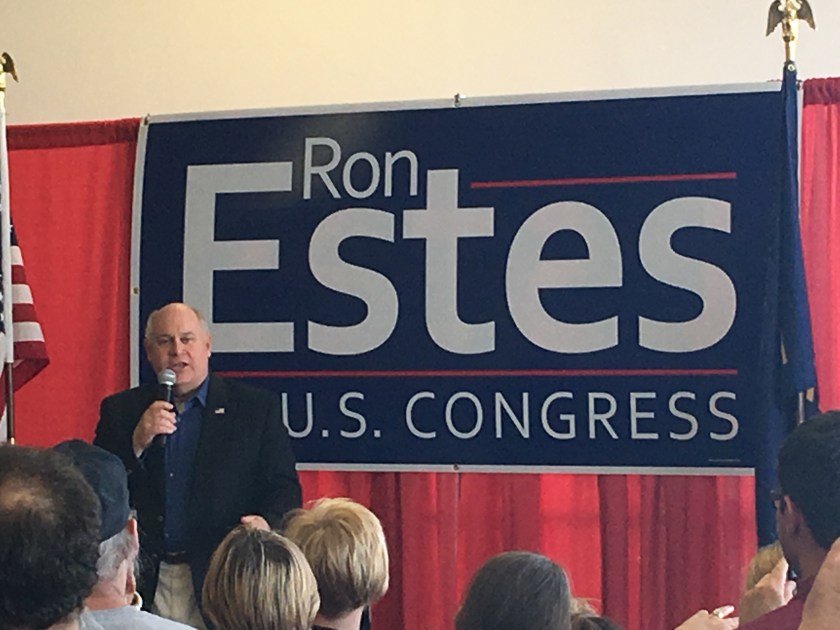
FILE PHOTO: Kansas Treasurer Ron Estes speaking to supporters at a rally the day before the election. (Photo credit: David de Sola)
During his victory speech, Estes took a shot at the skeptics who thought he was going to lose the race. From the Wichita Eagle’s report:
“We heard a lot from the national media and from people outside the state that we weren’t going to be able to win this race. We showed tonight that we were,” Estes said. “We’re still a Republican seat. … We sent a message across the country that we’re still Republican. That message should echo.
“For far too long, Washington hasn’t worked for us. We need to make sure that changes,” Estes said. “Tonight is a symbol of that.”
He dismissed “angst against the president” and that the election “was a chance for the Democrats.”
“We really showed the pundits tonight, didn’t we?” he asked, to applause and cheers.
Thompson started the night with strong numbers out of Sedgwick County – the most populous of the district’s 17 counties, which includes Wichita – in part because of early voting. Estes was able to make up an initial deficit of nearly 6,000 votes in Sedgwick County in more rural counties in the district as well as voters who turned out on Election Day. Thompson wound up winning Sedgwick County by 1,874 votes, but lost every other county in the district.
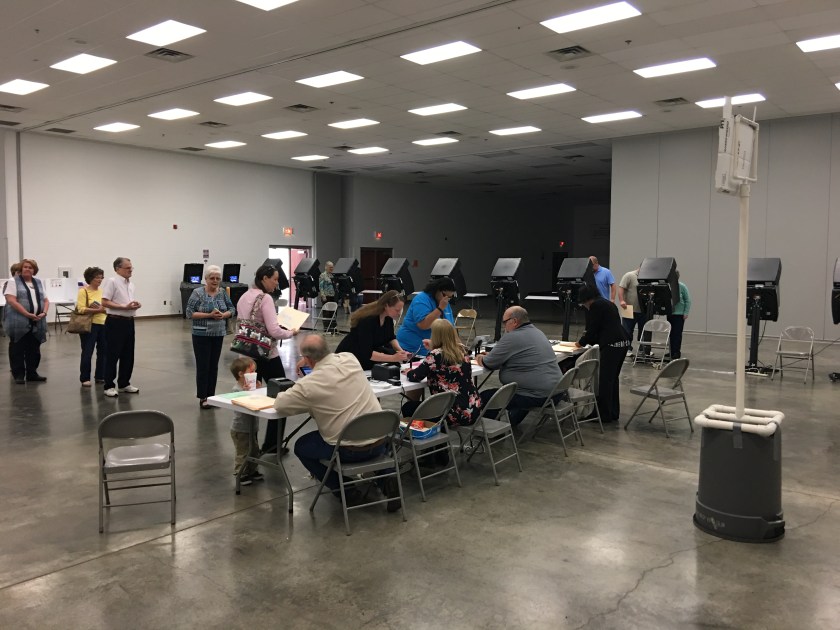
Voters at a Wichita area polling place on Election Day. (Photo credit: David de Sola)
Emily Percival, a registered nurse who works at a local hospital in Wichita, said she voted for Thompson because “I tend to care more about social issues than big business. Because of my profession, I frequently deal with the most vulnerable in our population,” and noted Kansas governor Sam Brownback’s recent veto of Medicaid expansion which passed with bipartisan majorities in both chambers of the state legislature.
Susan, a paraeducator and registered Republican, said she voted for Estes in part because of the national attention on the race. “The rest of the nation is looking at this election to see if we are supportive of Donald Trump’s initiatives,” she said, while also noting her pro-life position. She added that she had some issues with the negativity of Estes’s campaign commercial attacking Thompson on abortion, but noted “There’s never a perfect candidate.”
Mike, a retiree and registered Democrat, said he voted for Thompson because, “I’m not satisfied with the state government, which is run by Republicans. We need a change of everything, from the president on down.”
Greg Gourley, a registered Republican who works in the aerospace industry, said he crossed party lines and voted for Thompson. “Estes would support Brownback. I don’t agree with the policies of the current administration.” He also noted that he had voted for some Democratic candidates in the past, adding, “I tend to vote the issues, not the party.”
Barbara, a retiree, said “[Estes] is the best man for the job. He’s against late-term abortions. He’s a Republican, and I’d like to replace [Mike Pompeo] with another Republican.”
Sedgwick County Election Commissioner Tabitha Lehman told the Wichita Eagle that turnout could potentially double the expected 20 percent, though final numbers were still not available.
Although Republicans managed to avoid what would have been a shocking upset in this race, now they must focus their attention on the special election in Georgia’s Sixth Congressional District scheduled for next week. President Trump won that district by one point in 2016, and the Cook Political Report recently ranked the race as a toss up.
“The Democratic Party needs to remember there are more than just a few states that are in play. We need to make sure that they step up and help out and not wait until the last minute,” Thompson told reporters. “The national party was concentrating on Georgia. It’s a close race, and they should take that. We’ve shown that it’s possible. People didn’t give us credit here, didn’t think it was possible, but they came in at the last minute and tried to help out and we appreciate it. We need to make sure that we have a true 50-state strategy in place to make all races competitive.”
Though Thompson lost the election, Political Wire publisher Taegan Goddard noted the significance of the result: “A 20-point swing towards Democrats in KS-4 during Trump’s first 100 days — a.k.a. his honeymoon — is a political earthquake.”
According to Burdett Loomis, a political science professor at the University of Kansas, “[A Thompson win] would be a national event, interpreted as huge Trump loss. [A Thompson loss] under 10 point [margin] would be significant,” he wrote in an e-mail, noting this might make both national parties focus more attention on congressional races in the Second and Third Congressional Districts for the 2018 midterms.


 politicalwilderness.com